
In the rapidly evolving landscape of enterprise IT, data residency has emerged as a critical concern for organizations, particularly those operating in regulated industries. Data residency refers to the physical or geographical location where data is stored and processed. For many businesses, especially those in sectors such as finance, healthcare, and government, adhering to data residency requirements is not merely a compliance issue but a fundamental aspect of their operational strategy. In this context, the recent developments regarding the enforcement of data residency through single-region Claude Code on Amazon Bedrock present significant implications for enterprise IT marketing.
What Changed in Data Residency Enforcement?
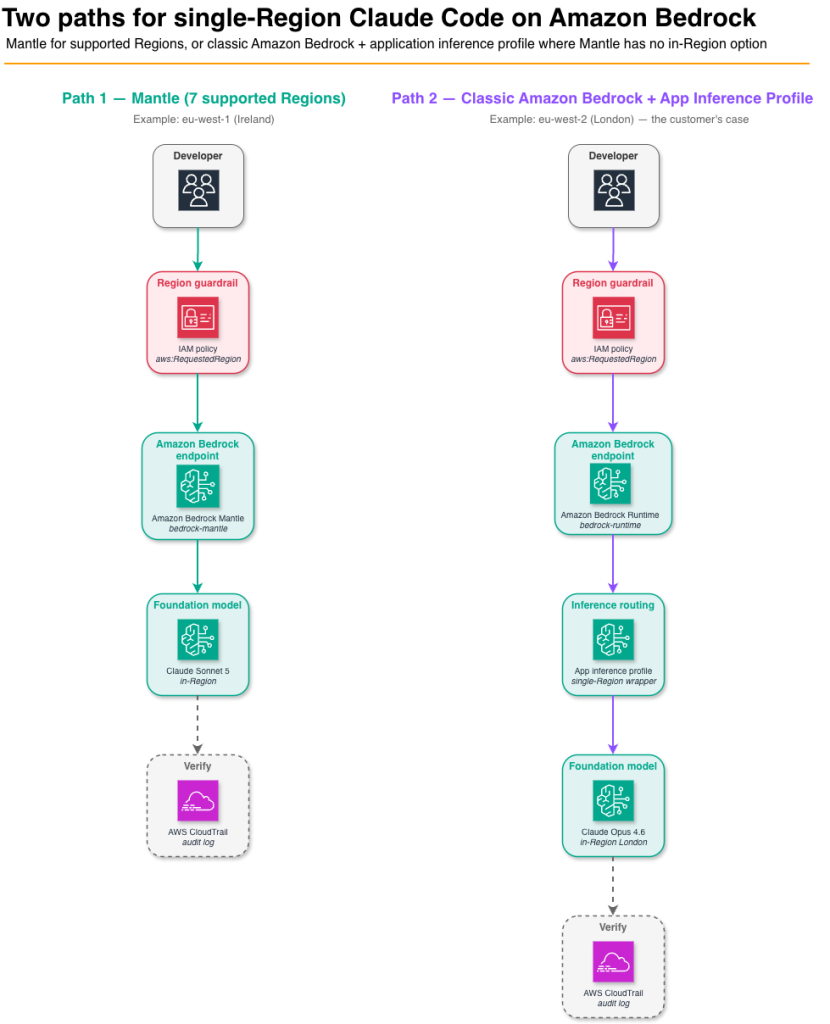
Traditionally, cloud services allowed for data to be processed across multiple regions, which provided flexibility and scalability. However, a recent case highlighted in the AWS Machine Learning Blog illustrates a shift towards stricter enforcement of data residency. A regulated customer required that all Claude Code inference be processed exclusively within a single AWS Region—specifically, London. This requirement is not just about geographical proximity; it is about ensuring compliance with local laws and regulations that govern data handling.
To facilitate this, AWS introduced two primary methods for pinning Claude Code to a single region: the application inference profile and the Mantle endpoint. These methods, when combined with an IAM (Identity and Access Management) Region condition, enable organizations to ensure that their data processing remains compliant with regional regulations. Furthermore, AWS CloudTrail can be utilized to verify compliance, providing an audit trail that confirms data residency adherence.
Why It Matters for Enterprise IT Marketing
For enterprise IT marketers, understanding the implications of data residency is crucial. As businesses increasingly prioritize compliance and data security, the demand for solutions that can guarantee data residency will grow. Marketers must be prepared to articulate how their products and services align with these regulatory requirements. This understanding not only helps in crafting effective marketing messages but also positions organizations as trusted partners in compliance.
Moreover, the emphasis on data residency can influence purchasing decisions. Organizations are likely to favor vendors who can demonstrate robust data residency capabilities. Thus, marketers should emphasize compliance features in their messaging, highlighting how their solutions can help clients meet local regulations while still leveraging the benefits of cloud technologies.
Practical Framework for Marketers
To effectively address data residency in marketing strategies, enterprise IT marketers can follow this practical framework:
- Understand Regulatory Requirements: Familiarize yourself with the data residency laws relevant to your target markets, especially in regulated industries.
- Highlight Compliance Features: Ensure that your marketing materials clearly communicate how your solutions support compliance with data residency requirements.
- Utilize Case Studies: Leverage real-world examples, such as the AWS case, to illustrate how your solutions have successfully addressed data residency challenges for clients.
- Engage with Stakeholders: Collaborate with legal and compliance teams to ensure that your marketing messages are accurate and align with organizational policies.
- Monitor Industry Trends: Stay informed about changes in data residency regulations and adjust your marketing strategies accordingly.
Implications for APAC and Hong Kong
In the Asia-Pacific (APAC) region, including Hong Kong, the importance of data residency is particularly pronounced due to the diverse regulatory landscape. Different countries within APAC have varying requirements regarding data handling and storage, making it essential for marketers to tailor their strategies accordingly. For instance, Hong Kong has specific regulations concerning personal data privacy that necessitate compliance from organizations operating in the region.
As cloud adoption continues to rise in APAC, the demand for solutions that can effectively manage data residency will likely increase. Marketers in this region should prioritize building trust with potential clients by demonstrating a clear understanding of local regulations and showcasing their solutions’ compliance capabilities.
Conclusion
In summary, the enforcement of data residency through single-region Claude Code on Amazon Bedrock marks a significant shift in how organizations must approach data handling in regulated environments. For enterprise IT marketers, this change presents both challenges and opportunities. By understanding the implications of data residency and effectively communicating compliance capabilities, marketers can position their organizations as leaders in the field. This article serves as a curated educational briefing for marketers looking to navigate the complexities of data residency in the context of enterprise IT. For further reading, please visit https://aws.amazon.com/blogs/machine-learning/enforcing-data-residency-with-single-region-claude-code-on-amazon-bedrock/.