
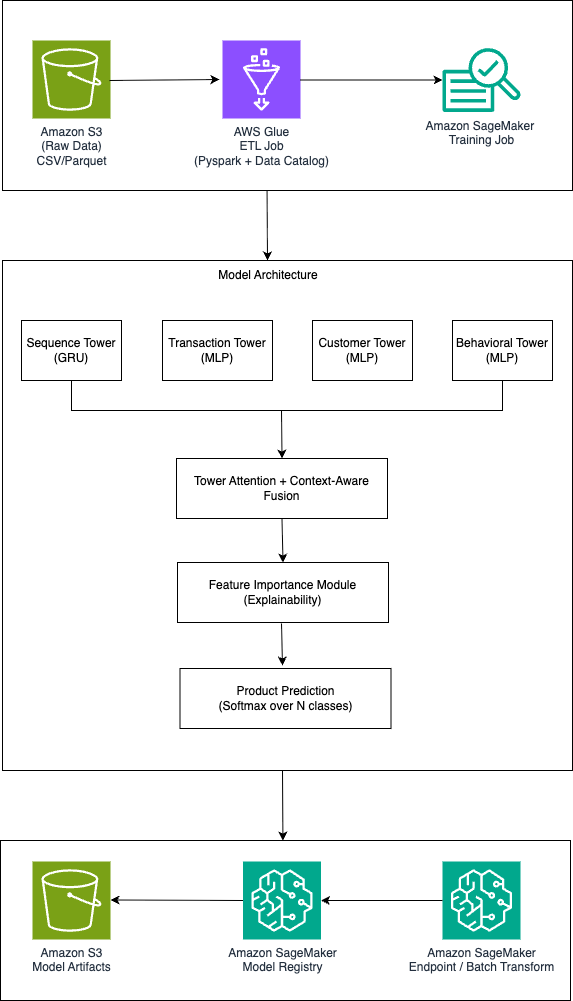
In the rapidly evolving landscape of enterprise IT marketing, the ability to deliver personalized customer experiences is paramount. One of the most effective ways to achieve this is through recommendation systems, which analyze customer data to suggest products or services that meet individual needs. This article delves into the architecture and design of explainable next-best-product recommendation systems, particularly in the banking sector, leveraging technologies such as Amazon SageMaker and PyTorch.
Understanding Recommendation Systems
Recommendation systems are algorithms designed to suggest products or services to users based on their preferences and behaviors. These systems can be broadly categorized into three types: content-based filtering, collaborative filtering, and hybrid methods. Content-based filtering recommends items similar to those a user has liked in the past, while collaborative filtering relies on the preferences of similar users. Hybrid methods combine both approaches to enhance accuracy.
Recent Advances in Explainability
As businesses increasingly rely on AI-driven solutions, the need for explainability in these systems has become critical. Explainability refers to the ability of a model to provide understandable insights into its decision-making process. In sectors like banking, where regulatory compliance is essential, explainable AI (XAI) ensures that recommendations can be justified to customers and regulators alike. The AWS Machine Learning Blog highlights a case study where a multi-tower neural network with learned attention mechanisms was employed to create an explainable recommendation system for banking.
Why Explainability Matters for Enterprise IT Marketing
For enterprise IT marketers, understanding the implications of explainable recommendation systems is crucial. Firstly, these systems enhance customer trust. When customers receive recommendations that they can understand and that are backed by transparent reasoning, they are more likely to engage with the products being suggested. Secondly, explainability aids in compliance with regulations, particularly in industries like banking where data privacy and ethical considerations are paramount. Marketers must ensure that their AI tools not only deliver results but also adhere to legal and ethical standards.
A Practical Framework for Implementing Explainable Recommendation Systems
To effectively implement an explainable recommendation system, marketers can follow a structured framework:
- Define Objectives: Clearly outline what you want to achieve with your recommendation system, such as increasing customer engagement or boosting sales.
- Choose the Right Technology: Select appropriate tools and frameworks, such as Amazon SageMaker for model training and PyTorch for building neural networks.
- Incorporate Explainability: Utilize techniques that enhance the interpretability of your model, such as attention mechanisms that highlight which features influenced a recommendation.
- Test and Validate: Continuously test your system with real customer data to ensure accuracy and relevance in recommendations.
- Monitor and Iterate: Regularly review the performance of your recommendation system and make adjustments based on customer feedback and changing market conditions.
Implications for APAC and Hong Kong Markets
In the APAC region, particularly in Hong Kong, the adoption of AI technologies in banking and finance is on the rise. As financial institutions strive to enhance customer experiences, the implementation of explainable recommendation systems can provide a competitive edge. However, marketers must also navigate the complexities of local regulations regarding data privacy and consumer protection. By prioritizing explainability, businesses can not only comply with these regulations but also foster stronger relationships with their customers.
Key Takeaways for APAC IT Marketers
- Emphasize the importance of explainability in AI-driven recommendation systems to build customer trust.
- Utilize advanced technologies like Amazon SageMaker and PyTorch to create robust and interpretable models.
- Adopt a structured framework for implementing recommendation systems to ensure alignment with business objectives.
- Stay informed about local regulations to ensure compliance while leveraging AI technologies.
- Continuously monitor and iterate on your systems based on customer feedback and market trends.
This article serves as a curated educational briefing on the significance of explainable recommendation systems in enterprise IT marketing, particularly within the banking sector. For further insights, please refer to the original source at AWS Machine Learning Blog.