
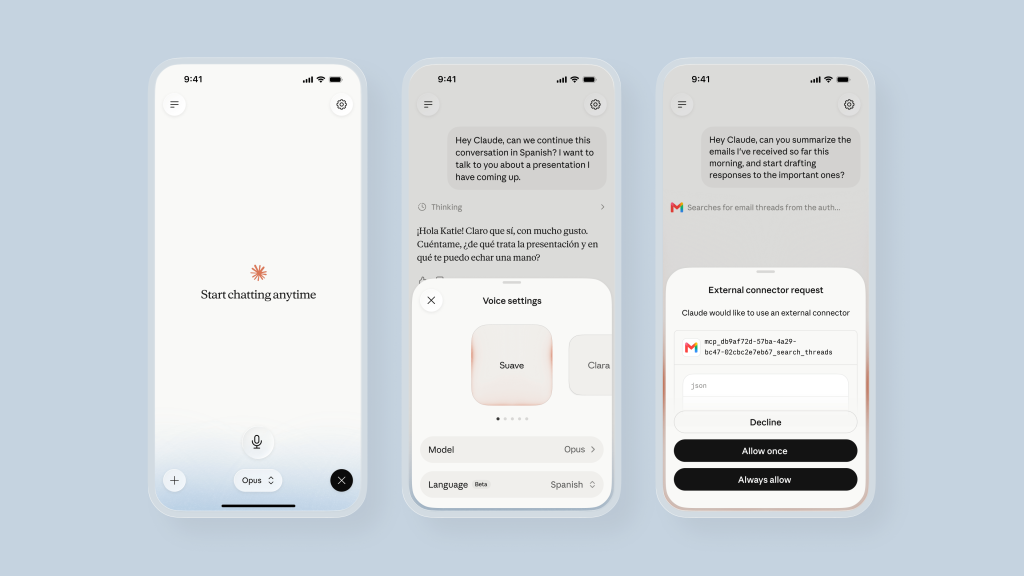
The landscape of artificial intelligence (AI) is continuously evolving, particularly in the realm of voice technology. Recently, Anthropic, a prominent player in AI development, announced the availability of voice mode for its Opus and Sonnet models. Previously, this feature was exclusive to the Claude Haiku model, which, while faster, is less powerful than its counterparts. This shift not only broadens the functionality of these AI models but also signifies a critical moment for enterprise IT marketing professionals to reassess their strategies and tools.
Understanding Voice Mode in AI
Voice mode refers to the capability of AI systems to process and generate spoken language. This technology allows users to interact with AI through voice commands, making it more accessible and user-friendly. The significance of voice mode lies in its potential to enhance user engagement and streamline communication processes. As AI systems become more adept at understanding and generating human-like speech, businesses can leverage these capabilities to improve customer interactions and operational efficiency.
What Changed with the Introduction of Voice Mode for Opus and Sonnet
With the introduction of voice mode for the Opus and Sonnet models, Anthropic is expanding the practical applications of its AI technology. This change allows these models to be integrated into widely used applications such as Gmail, Slack, and Canva, thereby enhancing their usability in everyday business operations. The previous limitation of voice mode to the Claude Haiku model restricted its application, but now, with broader access, enterprise IT marketers can explore new avenues for customer engagement and content delivery.
Why This Matters for Enterprise IT Marketing
The implications of this development are profound for enterprise IT marketing. First, the ability to utilize voice mode in popular applications means that businesses can create more interactive and personalized experiences for their users. For instance, integrating voice capabilities into customer service platforms can lead to faster response times and improved customer satisfaction.
Moreover, the rise of voice technology aligns with the growing trend of conversational marketing, where businesses engage customers through dialogue rather than traditional advertising methods. This shift not only enhances the customer experience but also allows for more effective data collection and analysis, enabling marketers to tailor their strategies based on real-time feedback.
Practical Framework for Implementing Voice Technology
To effectively leverage voice mode in marketing strategies, enterprise IT marketers should consider the following framework:
- Assess Your Needs: Identify areas within your marketing strategy where voice technology can enhance customer engagement or streamline processes.
- Choose the Right Tools: Evaluate the capabilities of the Opus and Sonnet models and determine how they can be integrated into your existing systems.
- Develop Content Strategies: Create content that is optimized for voice interaction, ensuring that it is conversational and engaging.
- Test and Iterate: Implement voice features in a controlled environment, gather feedback, and make necessary adjustments to improve user experience.
- Measure Success: Establish metrics to evaluate the effectiveness of voice technology in your marketing efforts, focusing on user engagement and satisfaction.
Implications for APAC and Hong Kong Markets
In the context of the APAC region, and particularly Hong Kong, the integration of voice technology in enterprise IT marketing holds significant potential. The region has a high smartphone penetration rate, and consumers are increasingly accustomed to voice-activated services. This trend presents an opportunity for businesses to adopt voice technology to meet the demands of a tech-savvy audience.
Furthermore, as companies in Hong Kong look to differentiate themselves in a competitive market, leveraging voice capabilities can enhance customer interactions and foster brand loyalty. Marketers should consider local language nuances and cultural factors when developing voice-enabled content to ensure relevance and effectiveness.
Conclusion
The expansion of voice mode capabilities in Anthropic’s Opus and Sonnet models marks a significant advancement in AI technology, offering new opportunities for enterprise IT marketers. By understanding the implications of this development and implementing a strategic framework, businesses can enhance their marketing efforts and improve customer engagement. This is a curated educational briefing with further insights available at https://www.theverge.com/ai-artificial-intelligence/970065/anthropic-voice-mode-claude-opus-sonnet-haiku-ai.